


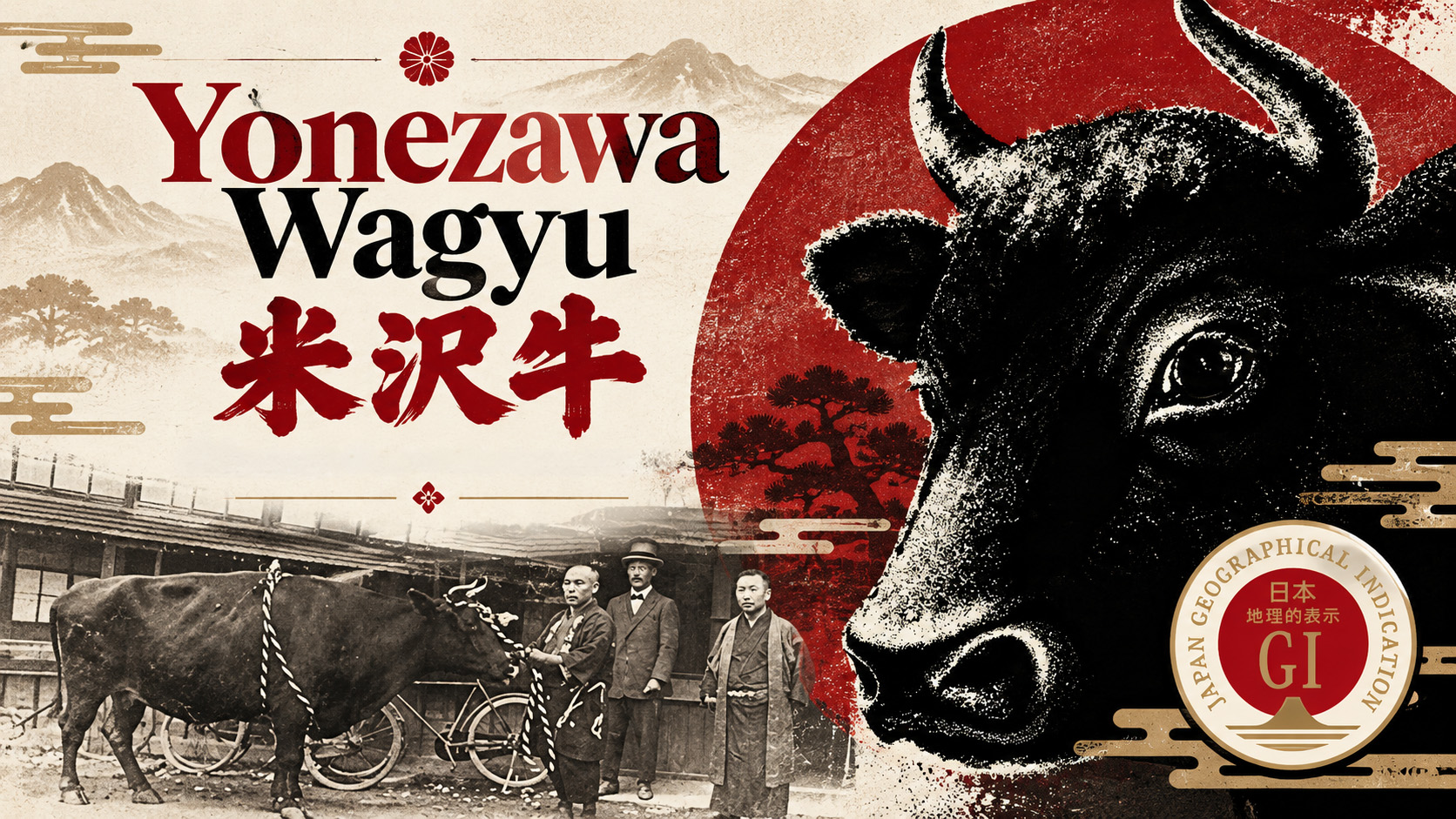

Yonezawa Beef: One of Japan's Leading Wagyu Brands, Alongside Kobe and Matsusaka
The Story of Yonezawa Beef
A Tale of Passion and Tradition Born in a Snow-Covered Basin — Over 150 Years of Yonezawa Beef
Located in the southern part of Yamagata Prefecture, the Okitama region is surrounded by steep mountains on all four sides. The history of Yonezawa beef dates back over 340 years to 1681, the first year of the Tenna era during the Edo period.
Under the rule of the renowned Uesugi clan, the Yonezawa domain brought sturdy cattle from the Nambu region (modern-day Iwate Prefecture) to be used for plowing fields, transporting goods, and producing the fertilizer essential for cultivation.
In this land of heavy snowfall, local farmers cared for these cattle as members of their own families, housing them under the same roof and raising them on high-quality local ingredients such as rice bran and straw.
This culture of treating cattle like family laid the vital foundation for the remarkable story of Yonezawa beef that would follow.
At the start of the Meiji era in 1871, Charles Henry Dallas, an English teacher, arrived in Yonezawa to take up a teaching position at Kojokan, the Yonezawa domain school.
During that time, Western culture was spreading rapidly across Japan. While beef consumption was becoming popular among foreign residents in Yokohama, it remained virtually unknown in Yonezawa.
Longing for the flavors of home, Mr. Dallas asked a local chef to prepare a meal using beef from Yonezawa cattle.
From the very first bite, he was astonished by the quality of the beef before him.
Raised amidst extreme seasonal temperature fluctuations in a pristine natural environment and receiving meticulous care from farmers, the beef featured fine fibers along with a sweet fat and delicate aroma unlike any beef he had ever tasted before.
In 1875, when his term ended and he had to leave Yonezawa, Mr. Dallas could not forget that impressive flavor. He took a live cow from the Okitama region back to Yokohama with him.
When he shared the beef with his foreign friends in Yokohama, it received overwhelming praise and quickly became a sensation.
The reputation that
“cattle from Yonezawa have an exceptionally superior taste”
began to spread from Yokohama throughout the country, and the name “Yonezawa Beef” has been etched into Japan's culinary history ever since.
Following the opening of Japan to the West, Yonezawa beef gained even more attention alongside the popularity of “Gyunabe” (beef hot pot), which later evolved into Sukiyaki and led to the continuous development of cattle fattening techniques.
During the Showa era, local farmers introduced high-quality Japanese Black (Kuroge Washu) cattle from western Japan to improve the breed and further elevate the meat quality.
Simultaneously, exceptionally strict standards were established, such as a long-term fattening period of no less than 33 months and the selection of only unbred heifers. Expert breeders dedicated themselves to the meticulous care of each animal throughout the rearing period.
In 2017 (Heisei 29), this consistent quality and long-standing cultural heritage were officially recognized by the Japanese government. It was registered under the Geographical Indication (GI) protection system as No. 26 by the Ministry of Agriculture, Forestry and Fisheries of Japan.
This marked a significant milestone as Yonezawa beef officially received a national seal of authenticity, befitting its long-established reputation.
From cattle once raised for agricultural labor in the Edo period to their discovery by an English teacher impressed by their flavor, Yonezawa beef has today risen to become one of Japan's top Kuroge Washu Wagyu brands, refined by the wisdom and expertise of breeders over many generations.
Within the melt-in-your-mouth fat and the deep umami that lingers after eating lies a story of pride and passion that has been passed down in the Okitama region for over 150 years.
Strict Conditions for Certification as “Yonezawa Beef”
The certification standards set by the Yonezawa Beef Brand Promotion Council are extremely rigorous.
Beef cannot use the name “Yonezawa Beef” simply because it was produced in Yamagata Prefecture; it must meet all five of the following essential conditions:
1) Production and Rearing Area
The cattle must be raised in the Okitama region of Yamagata Prefecture, which consists of three cities and five towns:
- Yonezawa City
- Nanyo City
- Nagai City
- Takahata Town
- Kawanishi Town
- Iide Town
- Shirataka Town
- Oguni Town
They must be raised under officially certified production standards.
2) Type of Cattle
The cattle must be Japanese Black (Kuroge Washu) unbred heifers only.
In other words, they must be female cattle that have never given birth.
3) Age of Cattle
The cattle must undergo a long-term fattening period and be at least 33 months old at the time of processing.
Long-term fattening is considered one of the key characteristics of modern Yonezawa beef.
4) Meat Quality Grade
The meat must receive a quality grade of 3 or higher according to the carcass grading standards of the Japan Meat Grading Association.
5) Certification and Verification of Authenticity
Beef that has been verified to meet all standards—including rearing area, calf origin, fattening method, and carcass quality—will be issued an official “Yonezawa Beef Certificate.”
Consumers can therefore verify authentic Yonezawa beef through this certificate as well as the official GI mark.
The Allure of Yonezawa Beef
Fine-textured meat, superior quality fat, and a rich, appetizing aroma blend perfectly to create the elegant, deep, and unique flavor of Yonezawa beef.
1) A Melt-in-Your-Mouth Texture — The Meticulous Use of Unbred Heifers
Yonezawa beef is restricted to Japanese Black unbred heifers only.
These heifers are characterized by exceptionally fine and tender meat fibers. When raised patiently over a long period, this helps develop high-quality fat structures that melt softly the moment they touch the palate.
This provides both richness and deep umami while remaining light and elegant, without feeling overly greasy or heavy.
This velvety smooth texture is one of the most important hallmarks of Yonezawa beef.
2) Rich Flavor and High-Quality Fat from Long-Term Fattening — Meticulously Raised for at Least 33 Months
Yonezawa beef is patiently raised and fattened for a period of no less than 33 months.
Long-term fattening increases the proportion of oleic acid in the fat, which contributes to the meat's tender texture and helps create a more delicate and mellow fat flavor.
The uniqueness of Yonezawa beef does not lie in having a large amount of fat alone, but in the balance between the sweetness of the fat, the naturally intense flavor of the lean meat, and the deep umami.
With each bite, the flavor of the meat gradually spreads across the palate while the fat melts softly, creating a complex and outstanding dimension of taste that is difficult for other types of beef to match.
3) Fine Marbling Nourished by Okitama's Nature — Extreme Climate and Pure Snowmelt Water
The Okitama region in Yamagata Prefecture features an inland basin climate with distinct temperature differences between seasons.
Summers are hot, while winters are severely cold with heavy snowfall.
Cattle that grow over a long period under these weather conditions develop firm and fine muscle structures, resulting in exquisite and beautiful marbling, or “Sashi.”
Additionally, the snow covering Mount Nishi-Azuma gradually melts into an abundant source of pure water that nourishes the land. This natural environment is a vital element that helps support the rich and unique flavor of Yonezawa beef.
Another experience not to be overlooked is the intense and uniquely charming “aroma” of Yonezawa beef. The moment the meat touches a hot iron pan or grill, a distinct, appetizing aroma from the beef fat rises. Upon eating, this aroma emerges along with the sweetness of the high-quality fat and the deep richness of the beef.
To summarize the perfection of Yonezawa beef:
- A melt-in-your-mouth texture
- The sweetness and richness of high-quality fat
- The deep natural umami of lean meat
- And a unique, appetizing aroma
No single element overpowers the others.
Every characteristic blends in perfect balance and harmony.
And that is the essence of “Yonezawa Beef.”